Number Logic Puzzle Challenge
Reviews
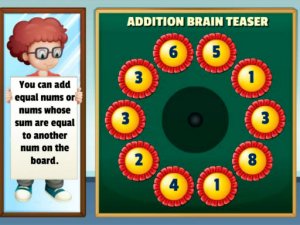
Number Logic Puzzle Challenge takes a familiar math-puzzle idea and adds a constraint that makes it genuinely strategic: you can only merge equal numbers or pairs whose sum matches another number still on the board. That rule forces you to read the whole board before each tap, and it rewards patience over speed. The lack of a timer and the family-friendly framing make it accessible, though players seeking action or competitive pressure will find it too quiet. Its strength is the steady difficulty curve and the satisfying logic of a clean clear.
Description
Combining Numbers with a Twist
Number Logic Puzzle Challenge asks you to empty a board full of numbers by tapping pairs that can be combined. The rule is simple but restrictive: two numbers can merge only if they are equal (3 and 3) or if their sum matches a number still present on the board (5 and 2 when a 7 remains). That second condition turns ordinary addition into a spatial and logical exercise, because the board itself determines which sums are legal at any moment.
Planning Each Move
Because every move changes what is possible, the order of your combinations matters as much as the combinations themselves. Clearing a number removes a potential sum target, so a pair that looks safe now might block a better move later. Scanning the whole board before tapping and thinking a few steps ahead are the habits that separate efficient clears from messy ones. There is no timer, so you can take as long as you need.
Difficulty and Progression
Puzzles typically grow more complex as you advance, introducing more numbers and tighter combination options. Early boards teach the rule; later ones demand pattern recognition and careful sequencing. The family-friendly design and absence of time pressure make it suitable for quick breaks or longer sessions, and each cleared board provides a clear sense of completion.
Who It Suits
This is a math puzzle aimed at players who enjoy mental arithmetic and logical deduction rather than reflexes. Its educational angle—practicing addition while solving a puzzle—makes it approachable for younger players, while the deeper planning required in later puzzles keeps it interesting for adults.




Editorial Notes