Math Gate Puzzle Challenge
Reviews
Math Gate Puzzle Challenge works because it strips arithmetic practice down to one decision: which gate matches the equation. The stickman presentation keeps the tone light, and the four basic operations give the puzzles enough range to stay interesting across short sessions. It suits children building arithmetic confidence and adults who want a quick mental warm-up. The main limitation is that the concept is intentionally simple, so players seeking deep progression or story will find it thin.
Description
Solving Equations on the Move
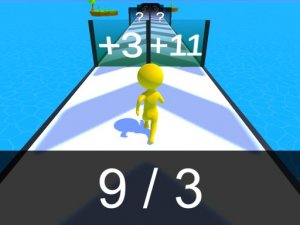
Each level in Math Gate Puzzle Challenge begins with an arithmetic problem displayed at the bottom of the screen. As the stickman advances, multiple gates appear in the path, each showing a different number. Only one gate carries the correct answer. The player must read the equation, calculate the result, and steer through the matching gate before reaching it. Choosing a wrong gate immediately ends the run.
Controls and Decision Pressure
Movement is handled with simple tap or swipe input, so the challenge comes from mental arithmetic rather than finger dexterity. Because gates approach steadily, players cannot pause to work out the answer on paper. The game rewards reading the problem early, estimating the result before the gates arrive, and committing to a lane without hesitation. This creates a loop where calculation speed and decision confidence are tested together.
Difficulty Curve and Session Length
Equations grow harder and the pace quickens as the player progresses, shifting the demand from basic recall to faster mental processing. Levels are short by design, which suits brief play sessions during breaks. The format also supports replayability, since each attempt is a fresh puzzle and a failed run can be retried immediately.
Visual Style and Audience
A stickman art style gives the game a light, playful look that matches its family-friendly tone. There is no inappropriate content, and the arithmetic spans addition, subtraction, multiplication, and division. That combination makes it approachable for children practicing basic operations and for adults who want a quick mental workout.







Editorial Notes