Tower Tumble Logic
Reviews
Tower Tumble Logic succeeds because its rule is easy to state and hard to master. Clearing one color while protecting the other turns every layout into a question of angles, rebounds, and order of operations. The limited shot count adds tension without a timer, and the gentle difficulty curve keeps early levels teachable. Bright colors and touchscreen support widen the audience. The main limitation is that the concept stays narrow: players who want story, scoring, or fast action will find little here.
Description
One Rule, Many Layouts
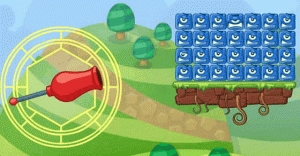
Tower Tumble Logic asks players to clear every block of a single color from a platform while leaving the other color untouched. That one rule drives the entire puzzle. Because the two colors sit together in different arrangements, each level becomes a question of order and contact: which block moves first, which block supports another, and which shot opens the board without disturbing the wrong color. The game rewards observation before action. Scanning the layout and tracing how blocks rest against each other matters more than firing quickly.
Shots, Angles, and Rebounds
Players aim a targeting mechanism and launch projectiles at the stack. The angle of the shot and the physical reaction of the blocks determine the outcome. Some blocks sit behind others, so a direct line is not always available. In those cases, players use rebounds or strike from above to reach the target. A limited number of shots per level adds weight to every decision. The result plays less like a reflex test and more like billiards or mini-golf, where planning two or three moves ahead is normal.
Difficulty That Builds Gently
Early layouts teach the basic idea: one clear target, one obvious angle. As players advance, arrangements grow tighter, direct shots become rarer, and some blocks sit partially hidden or need more than one hit to dislodge. The difficulty rises without becoming punishing. Players who want to refine their technique can replay earlier levels, which makes the game useful for short practice sessions as well as longer ones.
Designed for a Wide Audience
Bright, distinct colors separate the two block types at a glance. Controls support both mouse and touchscreen, so the game runs on desktop computers, tablets, and phones. The interface avoids text-heavy instructions, which keeps it usable for young children and for players who do not read English. There is no time limit, no violence, and no competitive scoring. The focus stays on problem-solving and spatial awareness, making it suitable for family play, classroom breaks, or quiet solo sessions.


Editorial Notes