Lightning's Off-Road Training Adventure
Reviews
Lightning's Off-Road Training Adventure is built around skill development rather than open-world racing. The strength is its structure: each course targets a specific ability, feedback follows every session, and unlocks reward improvement. Simple keyboard or touch controls make it accessible, and the gradual difficulty curve suits younger players or newcomers. The limitation is that it remains a training-focused experience, so anyone expecting a full racing campaign may find the format narrower than anticipated.
Description
Training Grounds and Terrain Variety
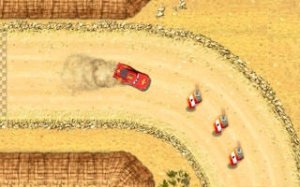
Lightning's Off-Road Training Adventure places Lightning McQueen on courses that range from rocky paths to tight, sharp turns. Each training session is built around a specific skill, so the terrain itself becomes the lesson. Slalom runs demand quick, precise steering to weave through markers, while endurance laps over rough ground test whether you can hold a line and maintain momentum when the surface fights back. The variety keeps repetition from feeling stale, because a course that rewards agility plays very differently from one that rewards toughness.
Controls and Session Structure
You accelerate, brake, and steer using either a keyboard or touch controls, and the game keeps that input scheme deliberately simple. Sarge delivers instructions at the start of each session, and following them closely is the difference between a clean run and a crash. Obstacles and sharp turns require you to read the course ahead rather than react late. After each session, the game provides feedback on your performance, which gives you a concrete starting point for the next attempt instead of leaving you to guess what went wrong.
Progression Through Practice
Completing challenges unlocks new courses and upgrades for McQueen, so progress is tied directly to demonstrated skill rather than time spent. Difficulty climbs gradually, which means the early courses teach the fundamentals you will need later without throwing you into a wall of impossible turns. The design encourages replay: running a course again to shave time or clean up a sloppy corner is a natural part of how the game works, and the feedback system supports that loop by highlighting specific areas to improve.
Who This Suits
Fans of the Cars films will recognize the characters and settings, but the game stands on its own as a skill-building driving experience. The accessible controls and clear objectives make it approachable for younger players or anyone new to driving games, while the gradual difficulty curve and replayable courses give experienced players something to refine. It is a game about practice and incremental improvement, not about instant mastery.





Editorial Notes