Pattern Fill Deduction Game
Reviews
Pattern Fill Deduction Game strips logic puzzles down to a single elegant rule: each number tells you how many orthogonal neighbors share its color. That constraint creates real depth as grids grow and clues thin out. The absence of timers and penalties makes it ideal for relaxed sessions, while later puzzles offer genuine challenge. Best for players who enjoy pure deduction without visual clutter or pressure.
Description
The Deduction Rule That Drives Everything
Every puzzle in Pattern Fill Deduction Game is built on a single constraint: a numbered tile states exactly how many of its four orthogonal neighbors—up, down, left, right—must share its color. A tile marked 4 requires all four adjacent cells to match; a 0 means none can. Because each clue limits the cells around it, the numbers interact. Satisfying one tile often forces choices elsewhere, and that chain reaction is the puzzle. There is no randomness and no guesswork. If you reach a contradiction, you made a logical error, not a bad roll.
How the Grids Get Harder
Early puzzles use small grids with plenty of numbered tiles. The clues are generous enough that you can often fill several cells from a single number, which makes the basic rule easy to internalize. Later puzzles expand the grid and thin out the clues. With fewer numbers to anchor your reasoning, you must combine information from multiple tiles—sometimes across the whole board—before you can place a single square. The difficulty rises smoothly rather than in sudden spikes, so each new puzzle builds on the last without feeling unfair.
Why the Interface Stays Out of the Way
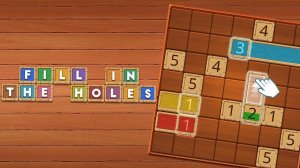
The visual design is deliberately plain. A neutral background and clearly defined cells keep attention on the numbers and their relationships. Color is used sparingly, only to mark filled squares, so there is no decorative noise competing with the logic. Some puzzles vary the grid size or introduce a different color palette, but the core presentation stays consistent. That consistency matters: when the board looks the same from puzzle to puzzle, you spend your attention on deduction instead of re-learning the layout.
Pacing for Short Breaks or Long Sessions
There are no timers, scores, or penalties. You can stop mid-puzzle and return later without losing progress. That makes Pattern Fill Deduction Game easy to pick up for a few minutes or to sit with for a longer stretch. The rules are simple enough for a child to learn, yet the sparser late-game grids offer real resistance for experienced solvers. The game respects your time by never punishing you for thinking slowly—the only pressure comes from the puzzle itself.








Editorial Notes